
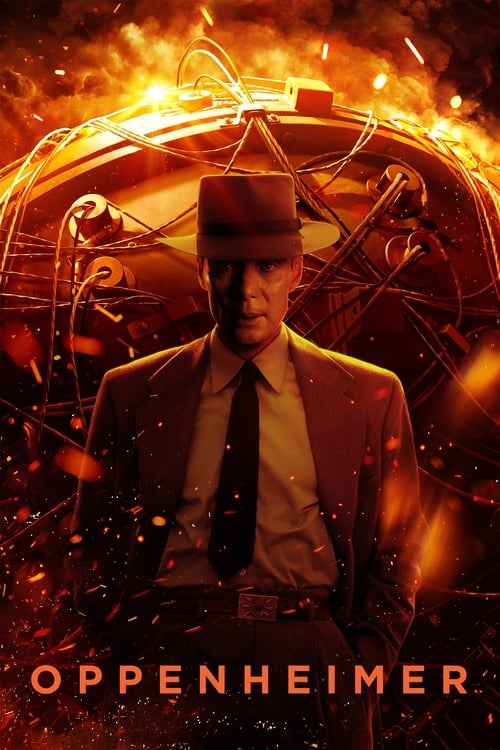
Oppenheimer (2023)
"The world forever changes."
Chronicles the life of theoretical physicist J. Robert Oppenheimer and his pivotal role in leading the Manhattan Project at Los Alamos to develop the first nuclear weapons during World War II.
Detailed Synopsis & Plot Analysis
Christopher Nolan’s "Oppenheimer" adapts Kai Bird and Martin J. Sherwin’s Pulitzer Prize-winning biography "American Prometheus" into a propulsive three-hour psychological thriller. Rather than treating the Manhattan Project as a conventional war drama, the film structures its narrative like a prism split between two distinct timelines and visual modes: "Fission," shot in vibrant 65mm color from Oppenheimer’s subjective perspective, and "Fusion," shot in stark 65mm black-and-white focusing on Atomic Energy Commission chairman Lewis Strauss.
The first half traces Oppenheimer’s early struggles as a theoretical physicist in European laboratories—where quantum mechanics keeps him awake with visions of subatomic waves—before returning to the United States to establish a premier quantum physics program at UC Berkeley. When World War II erupts and Nazi Germany begins researching nuclear fission, General Leslie Groves recruits Oppenheimer to direct a secret laboratory built from scratch on the mesas of Los Alamos, New Mexico.
The film’s thematic core emerges after the Trinity test in July 1945. Once the theoretical equation becomes a weapon of mass destruction, Oppenheimer realizes he has lost control over the political machinery of the Cold War. The final act intercuts the 1954 closed-door hearing—designed to strip Oppenheimer of his security clearance and silence his opposition to the hydrogen bomb—with the 1959 Senate confirmation hearing for Lewis Strauss, culminating in a haunting meditation on scientific hubris and existential chain reactions.
Critical Reception & Review Summary
"Oppenheimer" achieved rare critical and commercial synergy, grossing nearly $1 billion worldwide despite being a three-hour dialogue-driven historical biography. Critics overwhelmingly praised Christopher Nolan’s non-linear editing—executed by Jennifer Lame—which gives bureaucratic courtroom testimony the relentless momentum of a ticking-clock heist film.
Cillian Murphy’s performance drew universal acclaim for communicating immense internal pressure through subtle shifts in posture and a thousand-yard stare. Equally celebrated was Ludwig Göransson’s restless violin-driven score, which accelerates and decelerates tempo seamlessly without relying on percussion until the seismic footsteps of the gymnasium speech scene.
At the 96th Academy Awards, the film won seven Oscars, including Best Picture, Best Director (Christopher Nolan), Best Actor (Cillian Murphy), Best Supporting Actor (Robert Downey Jr.), Best Cinematography (Hoyte van Hoytema), Best Film Editing, and Best Original Score.
Cast & Crew Breakdown
Cillian Murphy
as J. Robert OppenheimerDelivers an Academy Award-winning portrayal capturing Oppenheimer’s intellectual charisma, moral torment, and psychological fragility across four decades.
Emily Blunt
as Katherine "Kitty" OppenheimerGrounds the domestic and political stakes, shining during the claustrophobic 1954 AEC security clearance hearing scenes.
Matt Damon
as Gen. Leslie GrovesProvides pragmatic military urgency as the no-nonsense engineer who recruits Oppenheimer to run Los Alamos.
Robert Downey Jr.
as Lewis StraussWon the Oscar for Best Supporting Actor for his nuanced transformation from welcoming patron to calculating political adversary.
Florence Pugh
as Jean TatlockBrings emotional volatility and tragic weight to the pre-war ideological circles that later haunt Oppenheimer’s security inquiry.
Production & Release Trivia
- To shoot the black-and-white "Fusion" sequences on large-format film, Kodak engineered the world’s first-ever 65mm black-and-white IMAX film stock (Kodak Double-X 5222) specifically for this production.
- The finished 70mm IMAX film print stretched over 11 miles long and weighed roughly 600 pounds, requiring modified platters in projection booths worldwide.
- Nolan wrote the screenplay in the first person ("I stare at the raindrops...") for all color scenes to remind the cast and crew that every frame in color represents Oppenheimer’s subjective memory and perception.
- The historic Los Alamos town sets were constructed on Ghost Ranch in New Mexico, while interior scenes of Oppenheimer’s actual cabin were filmed inside the real preserved cabin at Los Alamos.
Why You Should Watch
- ✓ Ideal for viewers who appreciate dense, fast-paced historical dramas like "JFK," "The Social Network," and "Chernobyl."
- ✓ Transforms complex scientific theory and Cold War political intrigue into a visceral sensory experience driven by world-class sound design and score.
- ✓ Features career-best ensemble acting where even five-minute cameo appearances (Gary Oldman, Benny Safdie, Kenneth Branagh) leave a lasting impression.